
Quality & Rule Book
by a fellow maker, for fellow makers
These are the rules I work by — what I promise, what I accept as natural, and how I deal with the small surprises that come with wood as a material. If you've ordered from Hobbymill before, none of this will surprise you. If you're new, this tells you what to expect.
What we promise
Every piece of wood that leaves the workshop:
- No cracks, mould, insect damage, or rot.
- Ships flat and straight from the workshop.
- Moisture content 8–12%.
Dimensions and tolerances
| Product | Thickness | Width | Length |
|---|---|---|---|
| Sheets for modelling | ±0.10 mm | −5 / +20 mm | ±20 mm |
| Planking sheets | ±0.10 mm | −5 / +20 mm | ±20 mm |
| Strips for planking | ±0.10 mm | ±0.10 mm | ±20 mm |
| Square strips | ±0.20 mm | ±0.20 mm | ±20 mm |
| Laserable sheets | ±0.20 mm | ±3 mm | ±3 mm |
| Knife blanks (40×30×140) | ±2 mm | ±2 mm | −0 / +10 mm |
| Pen blanks (19×19×130) | −0 / +2 mm | −0 / +2 mm | −1 / +5 mm |
| Coloured hornbeam (40×40×400) | ±2 mm | ±2 mm | −5 / +10 mm |
| Exotic hardwood lumber | ±2 mm | ±2 mm | −5 / +10 mm |
| Unique blanks | ±2 mm | ±2 mm | ±2 mm |
Unique blanks are sold piece-by-piece, photographed and numbered — the dimensions shown in each listing are accurate to ±2 mm in thickness, width and length.
How to read the thickness tolerance. Each product has its own figure in the table above — ±0.10 mm for sheets, planking sheets and strips for planking, and ±0.20 mm for square strips and laserable sheets. Whatever the figure, it describes variation between individual pieces, not thickness variation across a single piece.
Example (±0.20 mm laserable sheets): sheets sold as 3.0 mm may individually measure 2.85 mm, 3.1 mm or 3.2 mm and still be within specification. For a ±0.10 mm product the same logic applies with half the spread.
Uniformity within each piece is considerably tighter. Because sheets are precision sanded and calibrated, and strips are precision-sawn in a single setup, thickness across an individual piece is typically maintained within approximately ±0.05–0.10 mm.
This distinction is particularly important for laser cutting. A sheet that changes significantly in thickness from one side to the other can alter the effective focal distance during cutting. Our production process therefore prioritises not only accurate nominal thickness, but also a consistently flat and uniform thickness across each individual sheet.
In practical terms: a 3.0 mm sheet may actually be 3.1 mm thick, but it should remain approximately 3.1 mm throughout the sheet rather than measuring 2.8 mm in one area and 3.2 mm in another.
Surface finish
Sheets
Sanded to 120 grit on the visible surfaces, with crisp edges. Ready for your own finish-sanding to whatever grit your project calls for.
Laserable sheets
Sanded to 120 grit, ready for CO₂ laser cutting and engraving.
Strips and square strips
Precision-sawn on a Byrnes table saw — not sanded. The sawn surface is clean and consistent, but you may see very fine saw marks on one side under close inspection. A light pass with sandpaper before paint or finish removes them.
A note on sheet geometry
Our sheets are milled to consistent thickness across the whole piece, but the two long edges may not always be perfectly parallel to each other. The variation is small, but it's there. For most modellers this doesn't matter — you'll be ripping strips or cutting parts to your own dimensions anyway. If you need perfectly parallel edges for a particular project, order Custom Milled where each piece is cut to your exact specifications.
What is natural — and accepted
Wood is a living material. The following are normal and not considered defects:
Colour variation within a species
Swiss pear ranges from soft pink-cream to a deeper rose. Castello boxwood ranges from pale cream to a warmer yellow-cream. Black hornbeam ranges from deep black to occasional brownish streaks. Alaskan yellow cedar is the most uniform but can show subtle warm tones.
Small sound pin knots in fruitwoods
Swiss pear in particular naturally develops small, tight, light-coloured pin knots — these are part of the wood's character, not defects. They are firm, do not affect structure, and many modellers consider them attractive. Dead knots, black knots, and loose knots are never shipped.
One small black branchmark on modelling sheets
A single small black branchmark is accepted on a modelling sheet if the sheet is otherwise beautiful, consistent, and suitable for the project. This exception does not apply to laserable sheets — those must be clean enough for laser cutting and engraving.
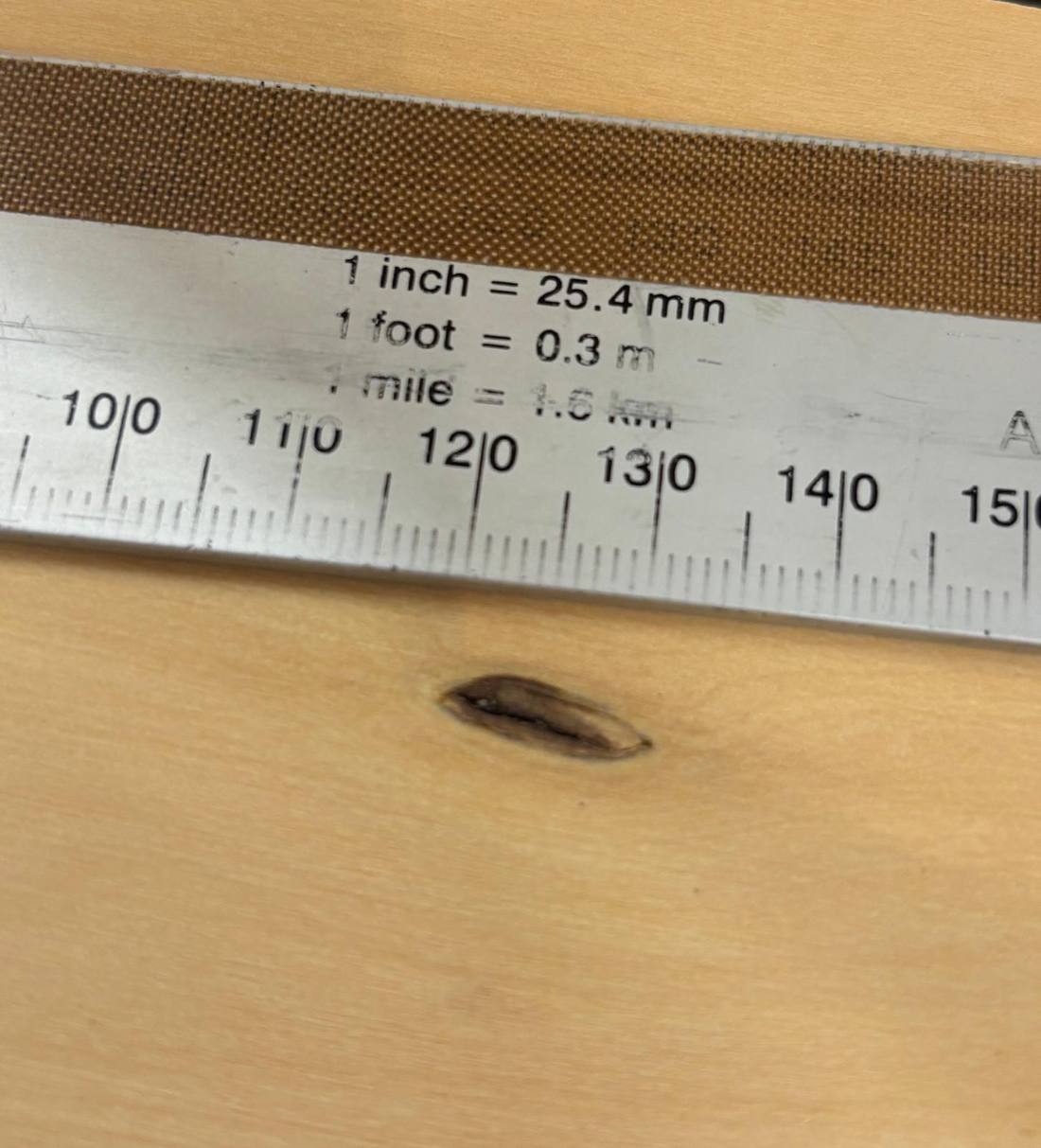
Example: one small black branchmark on an otherwise consistent modelling sheet — this is acceptable for general model work, but not for laserable sheets.
Subtle grain variation between pieces
Two sheets are never identical.
Natural ageing
All wood slowly deepens or lightens with exposure to light. Swiss pear in particular darkens beautifully over the first year.
Species-specific movement
Some woods are more sensitive to humidity than others. Alaskan yellow cedar in particular is known to move (cup or bow slightly) when it meets a new climate.
Movement in thin sheets
Sheets at 0.6–1 mm thickness are inherently sensitive to humidity changes and may show slight cupping or bowing after travelling between climates. This is easily corrected — see Handling your delivery below.
Handling your delivery
Wood that has been carefully dried in Estonia will need a short adjustment when it arrives at your workshop, especially if the climate is significantly different from ours.
Before opening
Let the sealed package rest in the room where you'll work with the wood for at least 24 hours. This step matters most for thin sheets (0.6–1 mm) and for Alaskan yellow cedar.
If thin sheets have cupped slightly in transit
Lay them flat on a smooth surface, place a flat board or two on top, and leave them overnight at room temperature.
After unpacking
Store unused wood flat, supported along its length, and away from direct sunlight or heat sources.
Why a portion is set aside
When timber arrives at the workshop, a meaningful portion gets set aside.
Not because it's bad wood. For general woodworking — furniture, turning, even most hobby projects — it would be perfectly fine. But for ship modelling, where every plank on a hull is seen, where the smallest colour shift breaks the illusion of a single piece of timber, "perfectly fine" isn't the same as right.
What we ship is the portion that's actually right for the job.
Colour matching within an order
Sheets (stock orders)
When you order multiple stock sheets, we do our best to pull pieces from the same batch, but we cannot guarantee zero colour variation across pieces — especially across different thicknesses, which are milled from different parts of the timber.
Strips (in packs of 10 or 50)
All strips within a single pack are colour-matched. No visible colour variation within the pack.
Custom Milled orders
Every piece in a custom order is cut from the same single piece of timber. Colour variation between pieces is essentially zero — they look like they belong together because they did, until they were milled. This is what serious modellers come to Hobbymill for.
We pack for the project, not the order line
Wood is a natural material, and even with the most careful inspection, a piece can have a defect that only shows once it's milled — a dark patch that runs deeper than expected, a colour shift on one edge, a tolerance error from a saw cut that didn't quite go right. We know what these materials are used for, and we know that running short of one piece can stall a build for weeks while replacement wood travels across continents.
So when it makes sense, we add a little to your order — enough that you can finish the project even if a piece doesn't work out.
This isn't a fixed policy. Sometimes the wood is uniformly perfect and we ship exactly what you ordered. Sometimes a particular batch needs an extra strip or sheet to be safe. The principle is simple: you ordered material to complete a build, not to count pieces.
If something is wrong
If a piece arrives with damage, missing pieces, defects beyond what's described here, or simply isn't right for your project — send a photo within 14 days and we'll make it right.